
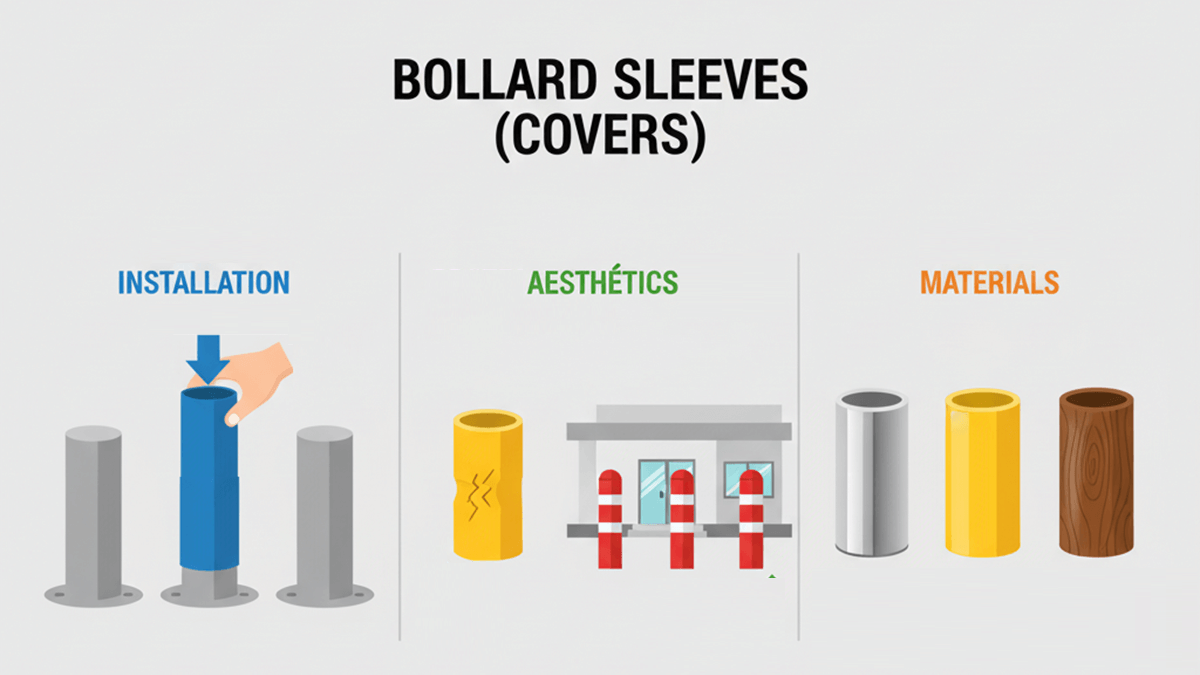
HVM security bollard sleeves allow a crash-rated bollard to complement the surrounding architecture without changing its essential security function. A properly designed sleeve can improve appearance, visibility, corrosion protection and maintainability, but it must remain compatible with the tested bollard core, foundation, spacing and operating mechanism.
On this page
- What is an HVM bollard sleeve?
- Does the sleeve affect the crash rating?
- Common sleeve materials and finishes
- How to calculate stainless-steel sleeve diameter
- Sleeves for fixed, removable and automatic bollards
- Corrosion and coastal-environment considerations
- Recommended design and approval process
- Bollard sleeve selection checklist
What Is an HVM Security Bollard Sleeve?
HVM means Hostile Vehicle Mitigation. It describes security measures designed to prevent or reduce the consequences of a vehicle entering a protected area deliberately or accidentally.
An HVM bollard normally has a structural core that resists the vehicle impact. A bollard sleeve is the visible outer cover fitted around that core. Depending on the bollard design, the sleeve may be removable, replaceable or permanently secured using an approved fixing method.
The sleeve can conceal a galvanised or coated structural core and give the bollard a finish that is more appropriate for a hotel, commercial building, government facility, public space, residential development or heritage environment.
A sleeve may be used to:
- Provide a stainless-steel or architectural finish.
- Match nearby railings, lighting columns and street furniture.
- Add reflective bands or contrasting colours.
- Carry a logo, emblem or project-specific design.
- Protect the core from scratches and normal environmental exposure.
- Allow the visible finish to be replaced without replacing the complete bollard.
Does the Sleeve Provide or Affect the Crash Rating?
The sleeve should normally be treated as an aesthetic and protective component rather than the primary impact-resisting component. The crash performance comes mainly from the structural bollard, foundation, reinforcement, anchorage, spacing and tested installation configuration.
Crash-testing standards assess the performance of the complete vehicle security barrier when struck by a specified vehicle at a specified speed and angle. The resulting classification records details such as the test vehicle, impact speed and penetration distance.
A sleeve may fall into one of three categories:
- Tested sleeve: The sleeve was installed during the original crash test.
- Manufacturer-approved sleeve: The manufacturer has assessed the sleeve and confirmed that it is compatible with the tested product.
- Project-specific sleeve: The sleeve is designed or fabricated separately for a particular architectural requirement.
A project-specific sleeve does not automatically cancel the bollard’s crash performance, but its dimensions, weight, fixing method and interaction with the bollard must be reviewed. The supplier or manufacturer should confirm in writing that the proposed sleeve does not interfere with the tested structural system or the operation of the bollard.
Common Materials Used for Bollard Sleeves
The best sleeve material depends on the bollard type, project appearance, exposure conditions, maintenance requirements and available budget.
| Material or finish | Typical advantages | Important considerations | Suitable applications |
|---|---|---|---|
| Stainless steel 304 | Clean appearance, good general corrosion resistance and widely available finishes. | May develop staining more quickly in coastal or chloride-rich environments. | Indoor areas, covered entrances and normal urban environments away from direct marine exposure. |
| Stainless steel 316 or 316L | Improved resistance to salt, moisture and aggressive outdoor conditions. | Requires correct fabrication, surface finishing, cleaning and isolation from dissimilar metals. | Waterfront developments, coastal projects, hotels, public spaces and premium building entrances. |
| Painted carbon steel | Wide choice of RAL colours and easy coordination with architectural metalwork. | The coating system must be suitable for outdoor exposure, and damaged areas require repair. | Commercial, industrial, traffic-control and colour-coordinated projects. |
| Powder-coated aluminium | Lightweight, corrosion resistant and available in many colours and textures. | May dent more easily than steel and requires suitable isolation from the structural core. | Decorative fixed bollards and lightweight removable sleeve applications. |
| Polyurethane cover | Resistant to minor knocks, easy to colour and suitable for high-visibility finishes. | Appearance may be less suitable for premium architectural projects and may weather over time. | Traffic management, car parks, industrial sites and high-use access points. |
| Vinyl-wrapped metal sleeve | Allows logos, graphics, advertising and temporary project branding. | The base sleeve still requires corrosion protection, and the wrap may need periodic replacement. | Events, branded developments, temporary campaigns and wayfinding applications. |
| Decorative cast-metal sleeve | Can reproduce heritage, ornamental or custom street-furniture profiles. | Weight, brittleness, fixing details and access for inspection must be considered. | Heritage districts, civic spaces, palaces and traditional architectural schemes. |
| Stone or marble cladding | Can coordinate with façades, paving and high-end landscape finishes. | Must remain decorative, with an independent structural bollard core. Fragmentation, weight and removal access require engineering review. | Hotels, luxury developments, ceremonial entrances and architectural landscapes. |
Choosing between stainless steel 304 and 316L
Stainless steel 304 is suitable for many normal environments. Stainless steel 316 contains additional alloying elements that improve resistance to chloride exposure, while 316L has a lower carbon content that is helpful when the material is welded.
For exposed coastal locations in the UAE, stainless steel 316 or 316L is normally the safer starting point. However, using 316L does not remove the need for proper surface finishing, regular cleaning, drainage and separation from dissimilar metals.
How to Calculate Stainless-Steel Sleeve Diameter
The sleeve must have sufficient internal clearance to slide over the structural bollard core without excessive force. The calculation must consider:
- The outside diameter of the structural core.
- The required radial gap between the core and sleeve.
- The thickness of the stainless-steel sleeve.
- Fabrication tolerances, weld distortion and the straightness of both components.
Step 1: Calculate the sleeve inside diameter
Sleeve inside diameter = Core outside diameter + (2 × radial gap)
IDsleeve = ODcore + 2g
The gap is multiplied by two because it is required on both sides of the bollard core.
Step 2: Calculate the sleeve outside diameter
Sleeve outside diameter = Sleeve inside diameter + (2 × sleeve thickness)
ODsleeve = ODcore + 2g + 2t
Where:
- ODcore = outside diameter of the structural bollard core
- g = radial gap between the core and sleeve
- t = sleeve wall thickness
- IDsleeve = required sleeve inside diameter
- ODsleeve = calculated sleeve outside diameter
Calculation example
Assume the following:
- Structural core outside diameter: 219 mm
- Stainless-steel sleeve thickness: 2 mm
- Required radial insertion gap: 1.5 mm per side
Sleeve inside diameter:
219 + (2 × 1.5) = 222 mm
Sleeve outside diameter:
222 + (2 × 2) = 226 mm
The theoretical sleeve dimensions are therefore:
Inside diameter: 222 mm
Outside diameter: 226 mm
Wall thickness: 2 mm
Recommended insertion gap
For a short, accurately fabricated fixed bollard sleeve, a radial gap of approximately 1.0 to 1.5 mm per side may be sufficient. A longer sleeve, site-fitted sleeve or fabricated sleeve with a longitudinal weld may require approximately 2 to 3 mm per side.
These figures are preliminary design allowances rather than universal requirements. The final clearance must account for:
- Actual measured core diameter rather than nominal pipe size alone.
- Pipe ovality, meaning that the pipe may not be perfectly round.
- Variation in stainless-steel sheet thickness.
- Distortion caused by rolling and welding the sleeve.
- Galvanising or paint thickness on the structural core.
- Internal weld-bead projection.
- The total sleeve length and required ease of removal.
Do not confuse radial gap with total clearance
A radial gap of 2 mm means there is 2 mm between the core and sleeve on each side. The total difference between the sleeve inside diameter and the core outside diameter is therefore 4 mm.
For example:
- Core diameter: 219 mm
- Radial gap: 2 mm
- Total diametral clearance: 4 mm
- Required sleeve inside diameter: 223 mm
Sleeves for Fixed, Removable and Automatic Bollards
The same sleeve design should not automatically be used for every bollard type. The available clearance, weight and fixing arrangement depend on how the bollard operates.
Fixed crash-rated bollards
Fixed bollards generally provide the greatest freedom for decorative sleeve design because there is no rising movement. Stainless-steel, painted, architectural, heritage and stone-effect covers may be possible, subject to maintaining inspection access and the approved structural configuration.
The sleeve should not be welded directly to the crash-rated core unless the bollard designer or manufacturer has approved the detail.
Removable crash-rated bollards
For removable bollards, the sleeve adds to the total lifting weight. Handles, locking mechanisms and lifting points must remain accessible. The sleeve must also pass safely into or above the receiving socket without creating an obstruction.
A heavy decorative sleeve can make manual operation difficult and may increase the risk of damage during removal and storage.
Automatic and retractable crash-rated bollards
Automatic bollards require the strictest dimensional control. The sleeve must not interfere with:
- The ground-level top plate or lid.
- Guide rings and seals.
- The rising and lowering movement.
- Integrated LED lights.
- Drainage openings.
- Maintenance and emergency operation.
The sleeve weight, straightness and concentricity can affect operation. For this reason, an automatic bollard sleeve should follow the approved product dimensions and should not be fabricated locally without technical confirmation.
Telescopic and stepped bollards
Some shallow-foundation automatic bollards use telescopic or stepped moving sections. These bollards can have different diameters at different heights, so a standard straight cylindrical sleeve may not be suitable.
The complete operating envelope—the space used by the bollard while moving—must be checked before the architectural finish is approved.
Architectural and Custom Bollard Sleeves
A custom sleeve can help an HVM scheme blend into its surroundings. The visible bollard may be designed to coordinate with street lighting, guardrails, planters, building façades or landscape features.
Common customisations include:
- Satin, brushed, bead-blasted or mirror-polished stainless steel.
- RAL-painted finishes.
- Flat, chamfered, domed or sloped tops.
- Recessed reflective bands.
- Laser-cut or etched logos.
- Government or corporate emblems.
- Decorative grooves and ribs.
- LED top lights or illuminated bands.
- Heritage-style cast profiles.
- Stone, marble or timber-effect outer finishes.
The architectural concept should be developed around the selected security bollard—not the other way around. Reducing the structural diameter, increasing the opening between bollards or altering the tested foundation merely to suit a preferred sleeve can compromise the security design.
Can Marble or Stone Be Used as a Bollard Sleeve?
Marble or stone can be used as an architectural outer finish around an independently designed crash-rated core. The stone should not be relied upon as the primary vehicle-impact component unless the complete stone-clad system has been specifically engineered and tested for that purpose.
The design should consider:
- Stone thickness and total weight.
- An internal support frame where required.
- Movement between the structural core and brittle stone.
- Fragmentation during a vehicle impact.
- Drainage and moisture accumulation.
- Access for core inspection.
- Replacement of cracked or damaged sections.
- Pedestrian safety and sharp broken edges.
A removable, segmented stone cover is often more practical than bonding the stone permanently to the structural bollard.
Corrosion and Coastal-Environment Considerations
A stainless-steel sleeve can hide the condition of the carbon-steel core. Water, sand and chloride deposits may become trapped in the gap, particularly in coastal and landscaped areas.
The design should provide:
- A properly galvanised or coated structural core.
- Drainage at the lower end of the sleeve.
- Ventilation where practical.
- Non-metallic isolation strips or spacers.
- Access for periodic removal and inspection.
- A cleaning plan suitable for the selected stainless-steel finish.
Preventing galvanic corrosion
Galvanic corrosion is accelerated corrosion that can occur when different metals remain in electrical contact while moisture is present. For example, a stainless-steel sleeve may be fitted around a galvanised carbon-steel core.
Direct wet contact can be reduced by using compatible non-metallic spacers, isolation strips or bushes. These components can also centre the sleeve and reduce rattling.
Maintenance in UAE coastal conditions
Stainless steel is corrosion resistant, but it is not maintenance free. Coastal salt, dust and pollutants should be removed through periodic washing with clean water and a suitable non-abrasive cleaner.
Highly polished or correctly brushed surfaces generally retain less contamination than rough, damaged or incorrectly finished surfaces. Cleaning tools previously used on carbon steel should not be used on stainless steel because they may transfer iron particles and create rust staining.
Reflective Bands and Visibility Features
Reflective bands help drivers and pedestrians identify bollards in low light. They may be applied as tape, formed as recessed bands, painted in a contrasting colour or incorporated into an illuminated detail.
Before adding a visibility feature, confirm:
- Whether the selected bollard permits machined or recessed bands.
- Whether the band could affect the thickness or strength of the sleeve.
- Whether the tape is suitable for outdoor heat and ultraviolet exposure.
- Whether the selected colour satisfies project or authority requirements.
- Whether automatic movement could damage or peel the band.
Lighting should also be coordinated with the bollard’s IP rating, wiring, access for replacement and operating clearances.
Sleeve Diameter and Bollard Spacing
A sleeve increases the visible outside diameter of the bollard. This reduces the clear pedestrian gap unless the bollard centre-to-centre spacing is adjusted.
However, increasing the centre-to-centre spacing may increase the clear security opening between the structural cores. Therefore, the spacing must satisfy both:
- The maximum permitted security gap for the tested or engineered HVM system.
- The required pedestrian, wheelchair and trolley access.
The designer should check the structural-core gap, the finished sleeve gap and the clear opening at the relevant height. A decorative sleeve should never be used as a reason to exceed the approved maximum structural spacing.
Recommended Bollard Sleeve Design and Approval Process
- Confirm the vehicle threat. Establish the required vehicle mass, speed, impact angle and acceptable penetration.
- Select the crash-rated bollard. Choose the structural system before finalising the decorative appearance.
- Obtain technical drawings. Confirm the core diameter, top-lid diameter, visible height and operating clearances.
- Define the environment. Identify coastal exposure, irrigation, road salt, chemicals, sand and cleaning conditions.
- Select the sleeve material. Choose the grade, thickness, finish and visibility features.
- Calculate the sleeve diameter. Include radial clearance, wall thickness and fabrication tolerances.
- Develop the fixing detail. Avoid unapproved welding or drilling into the structural core.
- Check bollard spacing. Verify both security and pedestrian clear gaps.
- Submit shop drawings. Show all interfaces, dimensions, fixings, drainage and material specifications.
- Obtain technical approval. Secure written acceptance from the responsible bollard designer or manufacturer.
- Produce a prototype. Confirm fit, appearance, removal and maintenance access.
- Inspect during installation. Check alignment, clearances and unobstructed operation.
Information Required to Design a Custom Sleeve
Before starting a sleeve design, collect the following information:
- Bollard manufacturer and model.
- Bollard operation: fixed, removable, manual or automatic.
- Crash-test classification or engineered performance.
- Actual structural-core outside diameter.
- Height above finished ground level.
- Top-lid or cap diameter.
- Automatic movement clearances.
- Required sleeve material and finish.
- Required reflective bands or lighting.
- Project exposure conditions.
- Required clear gap between finished bollards.
- Inspection and maintenance method.
Common Mistakes to Avoid
- Selecting the decorative sleeve before selecting the security bollard.
- Assuming the sleeve provides the crash rating.
- Using nominal pipe size without measuring the completed core.
- Providing insufficient insertion clearance.
- Ignoring weld-bead projection inside a fabricated sleeve.
- Welding or drilling into the crash-rated core without approval.
- Using a sleeve that obstructs automatic movement.
- Allowing water and salt to remain trapped between the sleeve and core.
- Increasing bollard spacing without checking the security opening.
- Using a heavy sleeve on a manually removable bollard.
- Covering locks, handles, drainage points or maintenance access.
- Describing a locally fabricated cover as independently crash rated.
HVM Bollard Sleeve Selection Checklist
- The required crash performance has been confirmed.
- The structural bollard has been selected first.
- The sleeve is compatible with the exact bollard model.
- The core has been physically measured.
- The sleeve inside and outside diameters have been calculated.
- Fabrication tolerances and insertion clearance are included.
- The material grade is suitable for the environment.
- Dissimilar metals are properly isolated.
- Drainage and inspection access are provided.
- The sleeve does not obstruct automatic movement.
- The finished pedestrian gap remains acceptable.
- The approved structural spacing is maintained.
- The fixing method does not alter the crash-rated core.
- The prototype has been checked before full production.
- The certification wording correctly describes the complete system.
Frequently Asked Questions
What is an HVM security bollard sleeve?
An HVM security bollard sleeve is the visible outer cover fitted around the structural core of a hostile vehicle mitigation bollard. It provides the required architectural finish, visibility and surface protection.
Is a decorative bollard sleeve crash rated?
A decorative sleeve is not normally crash rated by itself. The crash rating applies to the complete tested or approved barrier system, including the structural bollard, foundation, spacing and installation arrangement.
How is the required stainless-steel sleeve diameter calculated?
First calculate the sleeve inside diameter by adding twice the required radial gap to the core outside diameter. Then add twice the sleeve wall thickness to calculate the sleeve outside diameter.
How much gap should be provided between the bollard core and sleeve?
A preliminary radial gap of approximately 1 to 1.5 mm per side may suit a short, accurately fabricated fixed sleeve. Longer or site-fitted sleeves may require approximately 2 to 3 mm per side. Final clearance must consider actual measurements, ovality, coatings, weld distortion and manufacturer requirements.
Can a stainless-steel sleeve be fitted to any crash-rated bollard?
Not automatically. The sleeve dimensions, weight, fixing method and clearances must be compatible with the exact bollard model. Automatic and telescopic bollards require particular care because the sleeve can interfere with movement, seals or the ground-level lid.
Is stainless steel 316L suitable for coastal projects?
Stainless steel 316L is generally a suitable starting point for coastal environments because it offers better chloride resistance than grade 304. Proper finishing, drainage, isolation and regular cleaning are still required.
Can marble be installed around a crash-rated bollard?
Marble may be used as a decorative cladding around an independent crash-rated structural core. Its weight, support, removal method and fragmentation risk must be reviewed, and it should not be presented as the primary crash-resisting component.
Can the sleeve be welded to the structural bollard?
Direct welding should not be carried out unless it has been approved by the bollard designer or manufacturer. Welding can damage protective coatings, introduce corrosion points and alter the tested structural component.
Does a larger sleeve change the required bollard spacing?
A larger sleeve reduces the finished clear gap between bollards. The centre-to-centre spacing may only be changed after checking the approved maximum security opening and the required pedestrian-access gap.
Can a damaged sleeve be replaced without replacing the bollard?
A removable sleeve can often be replaced separately. However, after a vehicle impact, the structural core, foundation, alignment and operating system must be inspected before assuming that only the sleeve was damaged.
Related Articles
- How crash-rated bollards are tested
- Bollard materials and corrosion protection
- How to select the correct bollard
- Bollard spacing and layout design
- Bollard inspection and maintenance guide
Published by