
what K4 means, why it’s most requested, when to choose shallow vs deep, and what
Dubai/SIRA submittals should include.
Scope (fixed bollards only)
This page covers fixed (passive) crash-rated bollards—not automatic.
If you’re new to terminology, start with
Basics of HVM Bollards →
Bollard definition and
Bollards by function.
Dubai/SIRA note: SIRA documentation mentions PAS 68:2013 (crash test)
and PAS 69:2013 (selection/installation). For SIRA-led jobs, align wording with those pages
and your own SIRA content:
SIRA Crash Ratings,
SIRA Installation — What to Expect,
SIRA Foundations & Installation,
SIRA Documentation & Handover.
Standards landscape (what to state on submittals)
- Current international baseline: ISO 22343-1 (Vehicle security barriers — performance).
- Withdrawn internationally but still cited locally: PAS 68 (crash) and PAS 69 (selection/installation). IWA 14-1 is also withdrawn/superseded.
- For Dubai projects referencing SIRA, use PAS 68 wording for the crash statement and PAS 69 language for selection/installation.
Background: Global crash ratings and
How to read ratings.
Fixed vs automatic bollards — certification differences
Fixed bollards (this page): may be accepted by certified engineering calculations when permitted by the authority/spec; many products also have full-scale tests. The certification/engineering package always covers the bollard + foundation configuration (depth, plan, reinforcement, spacing). See
Foundation & installation dependencies.
Automatic bollards: certified as a system in the raised position (actuator + controls + safety + foundation cassette). Submittals include safety measures and interlocks:
Automatic HVM Bollard Controls and
Safety & interlocks.
What “K4” means (use US + metric)
Legacy DoS K4 ≈ stopping 15,000 lb (≈ 6,800 kg) at
30 mph (≈ 48 km/h) within a specified penetration.
Modern equivalence on submittals:
ASTM F2656 M30 (≈ K4): 6,800 kg (≈ 15,000 lb) @ 48 km/h (≈ 30 mph)
with penetration class P1/P2/P3 (P1 ≤ 1.0 m). For SIRA-led jobs, use PAS 68 phrasing for the tested case.
Background: Bollard crash testing and
Standards & terminology.
Why K4 bollards are the most requested bollard
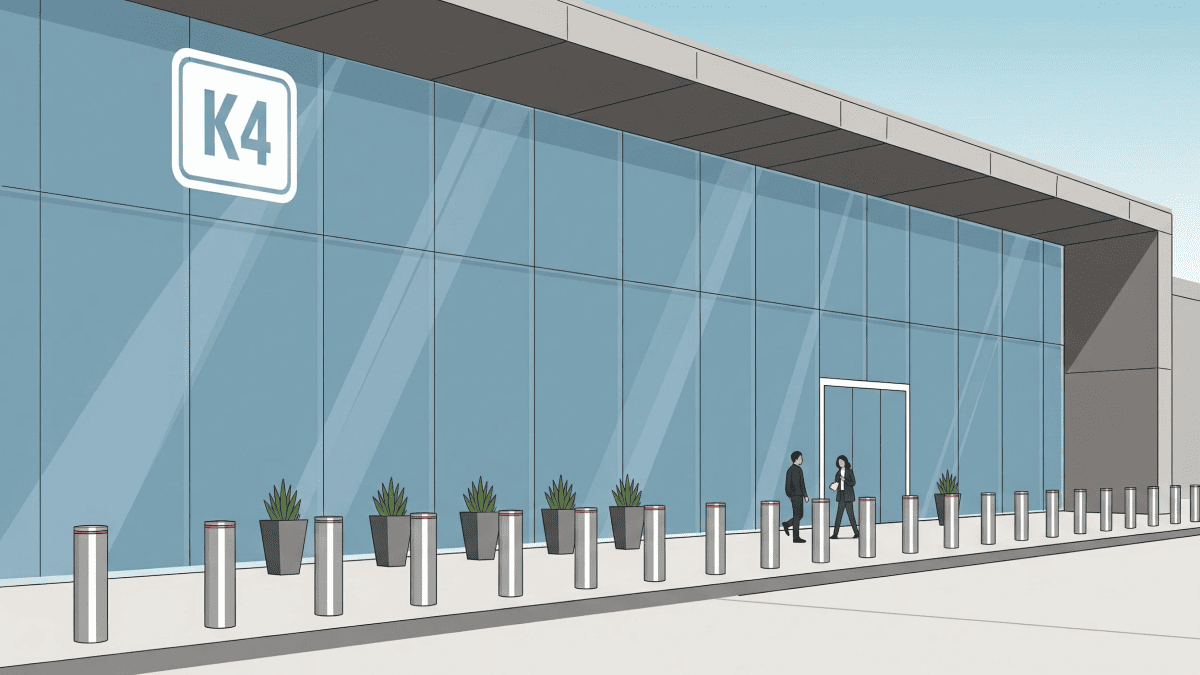
- Shopping-mall approach speeds are low. Geometry and calming keep approach speeds near
30 mph / 48 km/h —
see Approach run-up distance and
Terrain & calming effects. - Most façades don’t face highways. Urban streets limit run-up —
see Perimeter & approach paths. - Secure-by-Design sites. Street furniture and planters create barrier-by-design, reducing K8/K12 demand —
see Planning for HVM projects and
Security Bollards Design & Build — Scope.
Energy comparison (close to K4 family)
Rounded values; always submit the exact certificate/engineering basis for your product.
| Case (label) | Test mass | Test speed | US units | Metric units | Impact energy |
|---|---|---|---|---|---|
| ASTM M30 ≈ K4 (classic) | 6,800 kg | 48 km/h | 15,000 lb @ 30 mph | 6,800 kg @ 48 km/h | ≈ 604 kJ |
| PAS 68 N2 (common K4 family) | 7,500 kg | 48 km/h | 16,535 lb @ 30 mph | 7,500 kg @ 48 km/h | ≈ 667 kJ |
| IWA N2A (typical K4 family) | 7,200 kg | 48 km/h | 15,873 lb @ 30 mph | 7,200 kg @ 48 km/h | ≈ 640 kJ |
| PAS 68 table — N1G | 2,500 kg | 80 km/h | 5,512 lb @ 50 mph | 2,500 kg @ 80 km/h | ≈ 617 kJ |
| PAS 68 table — M1 high-speed (not K4) | 1,500 kg | 112 km/h | 3,307 lb @ 70 mph | 1,500 kg @ 112 km/h | ≈ 726 kJ |
For equivalency background, see
Standards equivalency.
Shallow-mount vs deep-mount (when & why)
Why shallow is requested more (even though system price is higher):
- Faster, cleaner installation with lower install cost/time. Live malls want minimal hoarding and noise.
- Avoid services. Retrofits sit over dense utilities; shallow cassettes avoid deep trenching near services.
Depth language to standardize:
- Deep-mount: > 500 mm and < 750 mm embedment (target ~500–600 mm).
See Foundations & loads. - Shallow-mount: < 200 mm embedment (certified cassette/array). Many systems require a
minimum array count and fixed spacing—check the certificate. See
Arrays & spacing and
Shallow foundations.
For installation steps, see
HVM Bollards Installation and the SIRA guide
Installation — What to Expect.
Engineering tasks & documentation
- Vehicle Dynamics Assessment (VDA): establish approach speeds/angles → choose rating & stand-off.
Start at VDA hub and use the
VDA worksheet. - Dynamic Load Assessment: verify forces into slabs/footings. A quick sense check:
Foundation moment quick estimator. - Foundation verification: certification is for the bollard system (incl. foundation).
Your footing depth/plan/rebar/concrete strength must match the tested/engineered configuration —
see Impact loads & foundations,
Foundation types,
Design checks,
and CAD/BIM Foundation typicals. - Follow approved drawings & rebar schedules: installers must build per
rebar cages & anchors. - Authorized installer: use a manufacturer-authorized installer to preserve certification and warranty —
see Warranty & spares policy. - Warranty: specify warranty for the bollard system (steel core + any cover)
and a separate warranty for installation workmanship.
Closeout aids: Handover pack index & checklists.
ATG K4 fixed bollards (QUA — authorized distributor & installer)
- ATG SP30 — fixed, K4/M30 family (deep-mount band: > 500 mm and < 750 mm; confirm exact).
- ATG SP400 SM 48 — shallow-mount (< 200 mm), K4/M30 family; cassette/array with defined minimum count & spacing.
See SIRA section: ATG HVM Bollards. For budgeting, see
Bollard cost UAE.
Buyer checklist (copy into RFP/BOQ)
- Rating line: “K4 (ASTM F2656 M30) fixed bollards — P-level required (P1 ≤ 1.0 m preferred).”
- Vehicle & speed (US + metric): 15,000 lb (≈ 6,800 kg) @ 30 mph (≈ 48 km/h).
- Foundation strategy: Deep-mount > 500 mm and < 750 mm (target ~500–600 mm)
or Shallow-mount < 200 mm cassette/array (state minimum array count & spacing). - Spacing: clear gap typically ≤ 1,200 mm (confirm certificate) —
Spacing rules. - Materials/finish: S355J2H (EN 10219), HDG ISO 1461, optional powder-coat (ISO 12944).
- Submittals: Crash certificate or engineering calculation package for the exact configuration,
GA/foundation drawings, rebar schedules, install tolerances; authorized installer credentials; warranty (system + installation).
See Documentation & certificates.
Advice for owners & consultants (maintenance / emergency access)
Use K4 fixed bollards to permanently block areas that should not be crossed. For
maintenance or emergency lanes, fixed K4 posts require cranes/rigging to remove—unlike decorative/parking posts; where regular vehicle access is needed, specify
automatic bollards for those lanes and keep fixed K4 where permanent blocking is required.
See Emergency service access.
FAQ
Is K4 the same as ASTM M30?
(e.g., 15,000 lb (≈ 6,800 kg) @ 30 mph (≈ 48 km/h), P1).
See Standards equivalency.
Can 1.5 t @ 112 km/h be called K4?
See How to read ratings.
How shallow can a certified fixed system be?
See Shallow foundations.
Why choose shallow on live sites if it costs more?
See Utilities conflicts & depth classes.
What documents besides the certificate?
structural drawings & rebar, authorized installer proof, and warranty
(system + installation). See
VDA and
Foundation design checks.
Project-scope note (Dubai / SIRA)
This page targets Dubai projects referencing SIRA. Some UAE projects outside SIRA still ask to
“comply with SIRA”; align wording with PAS 68 (crash) and PAS 69 (selection/installation) as cited in
SIRA text, and confirm any extra authority requirements with the client.
Published by