
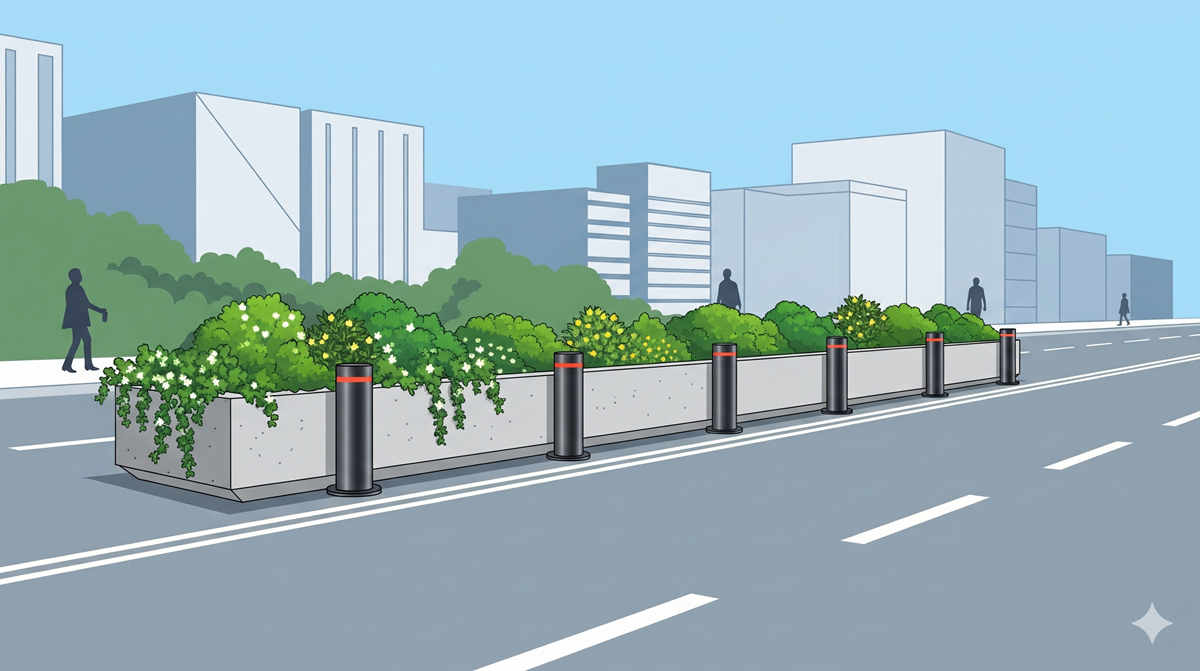
Modern urban design needs street furniture to do more than look good. In many commercial and public projects, planters, bicycle racks, and bollards are expected to improve the streetscape while also helping with safety, access control, vehicle mitigation, and public convenience. This is why designers increasingly explore ways to combine architecture, landscaping, and security in a single frontage strategy.

Street furniture with a security role
Cities are often described as concrete, glass, and steel environments, but current urban design increasingly tries to soften this with greener, more welcoming public spaces. That does not remove the need for security. In fact, it creates a more demanding design challenge: how do you preserve open, attractive public spaces while still reducing vehicle-related risk and maintaining safe pedestrian movement?
This is where multifunctional street furniture becomes important. Instead of relying only on obvious barrier hardware, designers may integrate protection into landscape and streetscape elements such as planters, bicycle-rack bollards, seating edges, and other fixed urban features. When done properly, these elements can help preserve the character of a place while still supporting a stronger perimeter or frontage strategy.
HVM or PAS 68 planters
HVM stands for Hostile Vehicle Mitigation, a term used for measures intended to reduce the risk of vehicle intrusion into buildings, people, and public-facing assets. A planter, by contrast, is a normal urban-design feature used to add greenery and soften hardscape. When these two ideas are combined correctly, the result is an HVM planter or crash-rated security planter.
An HVM planter can still support planting and landscape design, but it also contributes to perimeter protection. Depending on the product concept, the security performance may come from an integrated crash-rated bollard core or from a reinforced planter structure designed as a hostile-vehicle barrier system.
That makes security planters attractive for premium entrances, shopping centres, public plazas, transport facilities, and hospitality projects where a harsh visible barrier line may not suit the design intent. In these projects, the planter is not only decoration — it becomes part of the security strategy.
One mall-focused example is the SIRA approved HVM planter for malls in Dubai, which shows how a surface-mounted crash-rated planter can be used where bollards are not preferred and deep excavation is not practical.
In general, the visible planter shell may be made from different finishes and materials, but the real question is always the same: what is the actual crash-rated or engineered security basis behind the planter? A decorative planter alone is not automatically a security product.
Why HVM planters are attractive in urban projects
- they combine landscaping and protection
- they preserve pedestrian access and appearance
- they can reduce the visual harshness of obvious barriers
- they work well near glazing, drop-off zones, and public frontage areas
Bicycle parking bollards and bike racks
Bicycle use continues to grow in many cities as people seek healthier, lower-emission, and more flexible ways to travel. As a result, commercial buildings, residential projects, mixed-use developments, and public facilities increasingly need secure and well-planned bicycle parking.
Bollards can also support this function. By adding bike-locking arms or dedicated rack elements, bollards can become bicycle parking bollards. In these cases, the product is no longer only a marker or protective post — it also becomes a parking and convenience feature for employees, customers, residents, and visitors.
Well-designed bicycle parking bollards help prevent the common problem of bicycles being chained to benches, trees, handrails, or other unsuitable street furniture. They create a proper parking location and can improve the overall organization of high-traffic pedestrian zones.
In the right project, this kind of street furniture supports three goals at once: it improves convenience, encourages cycling, and keeps the frontage more organized.
Typical applications
Security planters and bicycle parking bollards are both used in public-facing urban spaces, but usually for different primary reasons. Common locations include:
- shopping centres and retail façades
- banks and commercial buildings
- stadiums and sports venues
- major railway stations and transport hubs
- theatres, public plazas, and civic spaces
- hospitality and mixed-use developments
Security planters are usually placed near entrances, waiting areas, façades, and frontage lines where the project needs both protection and an attractive visual treatment. Bicycle parking bollards, on the other hand, are more likely to be used near junctions, commercial frontages, mobility corridors, and other outdoor locations where easy cycle access matters.
In both cases, the product should match the actual use case. A bicycle rack does not become a security barrier just because it is made of steel, and a decorative planter does not become a real HVM system just because it is heavy.
How to choose the right supplier
Choosing the right supplier is essential because the market often uses terms like “security planter” and “security bollard” too loosely. Many suppliers use strong language for products that are decorative or only lightly protective, without a real crash-tested or engineered hostile-vehicle basis.
That is why clients should always ask direct technical questions. What crash rating or engineering basis supports this product? Is the visible unit the true structural barrier, or is there an integrated core? What layout, spacing, or foundation conditions are required for the claimed performance? Can the supplier provide product data, installation information, and project-specific technical support?
Where bicycle parking bollards are concerned, the questions are different. There, the focus is usually on usability, locking convenience, durability, finish, and outdoor service life rather than hostile vehicle mitigation. Mixing those two product families without clear definitions can create confusion in the project brief.
Installation and coordination
Installation requirements depend on the product type. A crash-rated planter may involve structural positioning, approved spacing, lifting procedures, and finish coordination. A bicycle parking bollard may be much simpler, but it still needs correct location planning, spacing, and coordination with pedestrian flow.
For security planters, the crash rating and exact protective arrangement are typically determined by the project’s security and site-planning requirements. The location, layout, and foundation or mounting approach need to be coordinated with the hardscape design and any architectural intent.
Where decorative lighting or special finishes are required, electrical and architectural coordination becomes important. Lighting details, wiring, and maintenance access should be resolved early rather than after the main installation is complete.
For bicycle parking bollards, the installation context is more about convenience, visibility, and practical use. These units are often exposed to weather, open circulation, and unsheltered pedestrian zones, so layout and durability are critical.
Challenges and maintenance
Outdoor planters and bicycle parking bollards both face maintenance challenges, though not always the same ones. Security planters may be exposed to heat, staining, cracking, leaks, finish damage, and long-term weathering. Metal planters can overheat and stress plants, while other finish types may require more specific care depending on sun exposure and irrigation conditions.
Clients should also pay attention to warranty. If cracks, dents, leaks, or finish damage appear under normal use, the replacement or repair responsibility should be clear. In security planters, cosmetic damage is not only an appearance issue — it may expose internal components to the environment and reduce the quality of the site frontage.
Bicycle parking bollards have their own outdoor durability concerns, especially in high-traffic public areas. Repeated use, accidental impact, abrasion, and exposure to weather can all affect their appearance and service life. In both cases, maintenance planning should be included from the start, not treated as an afterthought.
FAQs
What is an HVM planter?
An HVM planter is a planter system intended to combine landscaping with hostile vehicle mitigation. It should be backed by a tested or properly engineered security basis, not just decorative appearance.
Are all security planters crash-rated?
No. Many decorative or heavy planters are marketed as security planters without a genuine crash-rated or engineered hostile-vehicle basis.
What is a bicycle parking bollard?
A bicycle parking bollard is a bollard fitted or designed to help lock and organize bicycle parking, often in commercial or public-facing urban spaces.
Can one product provide both security and bicycle parking?
Sometimes, but the design intent has to be clear. A product meant for bicycle parking is not automatically suitable as a real hostile-vehicle barrier unless it has the correct supporting basis.
Why is supplier selection important?
Because many suppliers use security-related terms loosely. The right supplier should be able to explain the real function, basis, and installation requirements of the product being offered.
Published by