
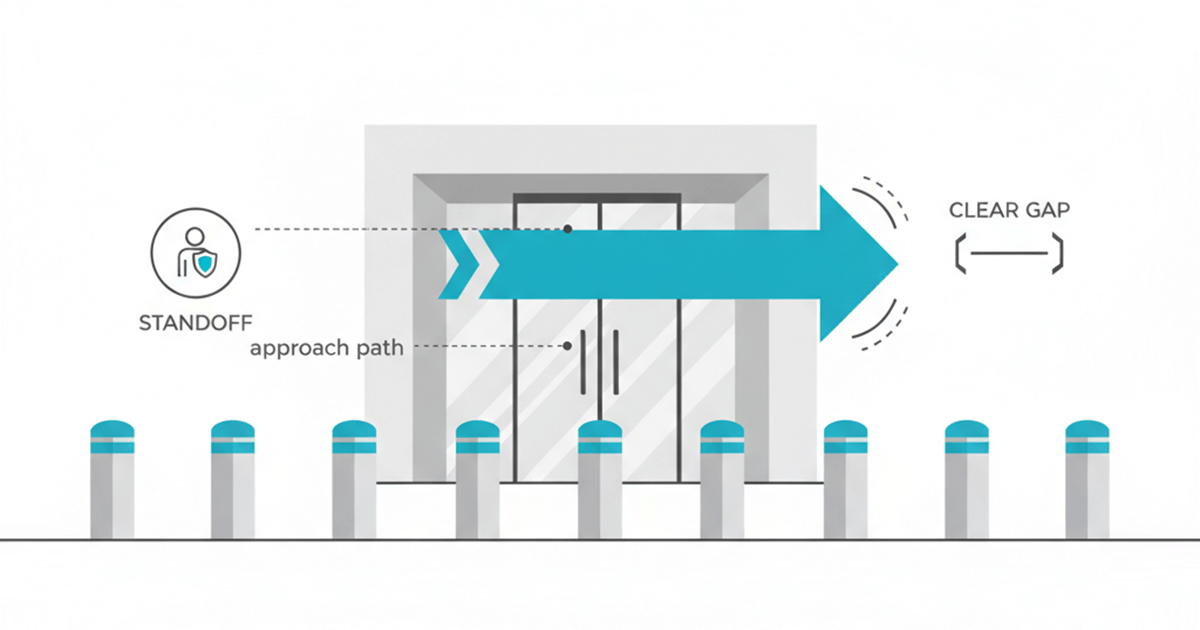
Security bollards design and build projects work best when roles are clear: a certified security consultant leads the VDA and protective layout, while we supply & install and design the bollard structure (tested model, foundations, integrations). This page explains who does what, what a VDA is, when it’s required, and what to prepare for a smooth, standards-aligned delivery.
1) Who Does What on a D&B Project
Certified Security Consultant (must-have)
- Leads threat/vulnerability assessment and sets the Operational Requirement (what is protected and to what level).
- Performs/oversees the Vehicle Dynamics Assessment (VDA); defines rating, standoff, array layout, clear-gaps, approach control, and allowable penetration.
- Issues stamped drawings/specs; liaises with authorities/landlord for approvals.
Main Contractor (Design & Build)
- Appoints the certified security consultant and design team; coordinates surveys, utilities, permits/NOCs, H&S, and phasing.
- Owns integration across trades (civil, electrical, access control, finishes) to deliver the approved design.
Our Role (Supplier/Installer)
- Recommend suitable models (safety or crash-rated/HVM) with certificates, datasheets and manufacturer foundation details.
- Advise on controls (power, loops, photo-eyes, EFO, fail-state), buildability, and maintenance.
- Execute installation and commissioning in line with the approved, consultant-led layout.
This security bollards design and build guide clarifies consultant, main-contractor and supplier responsibilities so your approvals and installation stay aligned.
2) Four Purposes → Different Requirements
- Building Security (façades/glazing), People Safety (public/car-park edges), Asset Protection (compounds/equipment), Access Control (lanes/gates).
- Decide early if the brief is low-speed safety (driver error) or HVM crash-rated (threat-led). The consultant formalizes this in the specification.
3) VDA—What It Is, Who Does It, When It’s Required
What VDA Includes
- Maps approach routes/run-up distances, turning radii, gradients and realistic attack vectors.
- Estimates achievable impact speed/angle; sets standoff, array, and clear-gaps to block vehicle ingress yet keep pedestrian access.
- Checks subsurface constraints (depth, utilities) to select standard vs. shallow-mount foundations.
Who Performs It
A qualified security consultant or their specialist performs the VDA. Suppliers don’t set threat or certify adequacy; we support with product data and as-built delivery.
When It’s Required
- Whenever crash-rated (HVM) measures are considered, or where credible vehicle approach risks exist.
- Often expected/required by authorities, clients and insurers as evidence that the solution is proportionate and effective.
Standards & Methods (selection)
Use recognized crash testing/selection references (e.g., IWA 14, ASTM F2656) and established layout/installation guidance so the installed array replicates the intended performance. VDA commonly includes swept-path and speed modeling.
VDA is the evidence base that turns a security bollards design and build brief into a buildable, standards-aligned layout with the right rating and standoff.
4) Street Furniture and Landscaping—In or Out?
- Include in VDA: planters, benches, walls, lighting columns, kerbs, terrain changes—attackers ignore normal traffic rules.
- Count only engineered or certified elements toward stopping power (e.g., reinforced planters/walls with evidence). Decorative items aren’t protective.
5) What We Need to Propose Products (Fast)
- Site plan (CAD/PDF), entrance widths/curbs, services near foundations.
- Defined purpose(s) and whether it’s low-speed or HVM; target rating/penetration for HVM.
- For automatic lanes: power route, control cabinet, safety devices, fail-state/EFO, interfaces (BMS/FA/access).
- Finish/aesthetics (stainless/painted, sleeves, lighting) and duty cycle/environment.
6) UAE Note (Approvals)
In Dubai, projects within scope typically require a SIRA-approved plan prepared by a licensed consultant before works. Other emirates coordinate via the relevant municipality/MOI directorates. The main contractor/consultant handle submissions and NOCs; we install to the approved package.
Typical Deliverables from Us
- Shortlisted models (safety or HVM) with certificates, datasheets, foundation drawings.
- Method statement, cable/controls notes, commissioning & operator training.
- O&M and preventive maintenance plan with recommended spares.
Explore more on security bollards design and build in our Articles hub.
Related Articles
- What to Expect During Bollard Installation
- Bollard Installation Guide
- Bollard Crash Testing
- All Articles
Design & Build for Bollards — FAQ
What is a Vehicle Dynamics Assessment (VDA)?
Who performs the VDA?
When is VDA required?
Which standards should guide VDA and specification?
Are planters, benches and other street furniture included in VDA?
Which bollards are “involved” in VDA?
How does a security bollards design and build project split responsibilities?
Who prepares the bollard specification?
Do UAE projects need special approvals?
Published by